Heating Repair in Schertz, TX

Facing Unexpected Heating Failures?
When your heating system breaks down, the discomfort isn't just painful—it disrupts your whole day. Our expert team in Schertz, TX is ready to bring quick, effective repairs right to your doorstep, so contact us today to schedule your service or discuss financing options.
- Speedy Service: Same-day repairs to get you warm and comfortable without the wait.
- Trusted Expertise: Over 30 years serving Schertz with high satisfaction rates.
- 24/7 Availability: Emergency? We're ready round the clock—no extra charges for night or weekend calls.
All services backed by a comprehensive warranty for your peace of mind.
What You Get With Our Immediate Response Service
A broken heater is an urgent matter, particularly when a cold front settles into the region. You cannot afford to wait for a technician who might show up days later or lacks the necessary parts to complete the job on the first visit. When you request service from ReliaBee Air, Electric, & Plumbing, you are engaging a team that prioritizes dispatch speed and technical readiness.
We understand that heating issues rarely happen at convenient times. The system usually fails when it is under the most stress, such as during the first freeze of the year or in the middle of a winter night. Our approach is built on rapid mobilization. We deploy fully stocked trucks carrying the most common repair parts—including igniters, flame sensors, capacitors, and control boards—to your location in Schertz. This inventory strategy allows us to resolve the vast majority of heating malfunctions in a single trip, restoring warmth to your home immediately.
You also receive transparency regarding the scope of work. Before any tool touches your equipment for a repair, our technicians provide a clear explanation of the failure, the proposed solution, and the exact cost. There are no hidden fees or surprise charges on the final invoice. We focus on diagnosing the root cause rather than just treating the symptom, ensuring the repair holds up against future weather fluctuations.
How Our Heating Repair Works
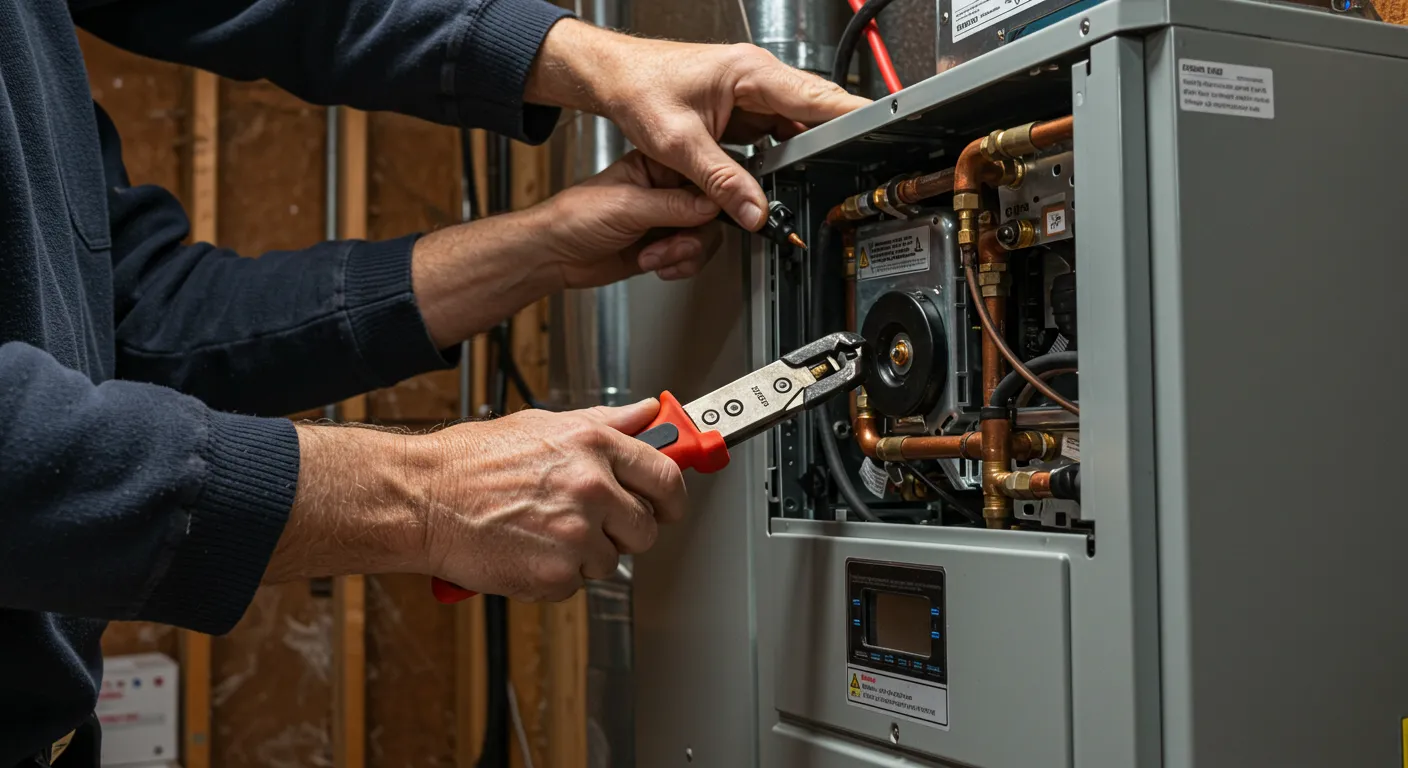
Effective heating repair requires a systematic approach to troubleshooting. Modern HVAC systems are complex networks of electrical circuits, gas lines, and airflow mechanics. Guesswork is not an option. Our certified technicians follow a rigorous diagnostic protocol to ensure safety and efficiency.
- System Diagnostics and Safety Inspection: The process begins with a comprehensive safety check. For gas furnaces, we inspect the heat exchanger for cracks, check gas connections for leaks, and test carbon monoxide levels to ensure your home is safe. For electric systems and heat pumps, we analyze voltage, amperage, and electrical connections to identify potential fire hazards or short circuits.
- Component Testing: We isolate the specific component causing the failure. This involves testing the thermostat communication, the ignition sequence, and the blower motor operation. We verify that the system is receiving the signal to heat and that all safety switches—such as limit switches and rollout switches—are functioning correctly.
- Precision Repair: Once the issue is identified, we proceed with the repair. This may involve cleaning dirty flame sensors, replacing a faulty igniter, swapping out a seized motor, or unclogging condensate lines in high-efficiency units. We use OEM-specified parts to ensure compatibility and longevity.
- Airflow and Pressure Verification: A heater cannot function without proper airflow. We inspect the filter, return air ducts, and supply registers to ensure there are no blockages. We also measure static pressure to confirm the blower is moving air efficiently, which prevents the system from overheating and shutting down prematurely.
- Final Performance Testing: We do not leave until the system is running a full cycle. We monitor the temperature rise (the difference in temperature between the air entering and leaving the unit) to ensure it falls within the manufacturer’s specifications. This confirms that the repair was successful and that the unit is operating at peak efficiency.
Diagnosing Common Heating System Malfunctions
Heating systems in our area face specific challenges due to the climate. While winters are generally mild, the systems sit dormant for months, accumulating dust and debris. When they are finally kicked on, or when they have to work overtime during a cold snap, several common components tend to fail. Understanding these failures helps in making informed decisions about repairs.
- Ignition Control Failures: In modern gas furnaces, the pilot light has largely been replaced by electronic ignition systems (hot surface igniters or intermittent pilots). These components are fragile and have a limited lifespan. If your furnace clicks but does not fire, the igniter is often the culprit.
- Thermostat Calibration Issues: Sometimes the heater is fine, but the "brain" of the system is confused. Miscalibrated thermostats can read the room temperature incorrectly, causing the heater to run constantly or not at all. We check for wiring issues, battery failures, and location problems (such as a thermostat placed near a drafty window) that affect performance.
- Blower Motor Malfunctions: The blower motor is responsible for circulating warm air throughout the house. If the motor burns out, runs at the wrong speed, or if the capacitor starting the motor fails, you will have little to no airflow. This often results in the furnace overheating and tripping safety limits.
- Heat Pump Reversing Valve Issues: Many homes in the region utilize heat pumps. These units heat and cool the home. The reversing valve is the component that switches the flow of refrigerant to change modes. If this valve gets stuck, your system might blow cold air when you are asking for heat.
- Clogged Air Filters and Dirty Coils: Restricted airflow is the leading cause of premature system failure. A clogged filter restricts air intake, causing the heat exchanger to overheat. In heat pumps, dirty coils prevent proper heat transfer, driving up energy bills and reducing output.
When Replacement Beats Repair
Deciding between repairing an existing unit and investing in a replacement is a financial and practical calculation. While our primary goal is to repair your system and extend its life, there are mathematical tipping points where repair becomes "throwing good money after bad."
We recommend evaluating the "50% Rule." If the cost of the necessary repair approaches 50% of the value of a new system, replacement is generally the wiser financial move. Additionally, if you multiply the age of your equipment (in years) by the cost of the repair (in dollars) and the total exceeds $5,000, it is often more economical to replace.
- Age of the System: The average lifespan of a furnace or heat pump is 15 to 20 years. If your system is over 15 years old and requires a major part—like a heat exchanger or compressor—replacement offers better long-term value.
- Frequency of Breakdowns: If you have required multiple repairs in the last two seasons, your system is likely entering the end-of-life phase. Continual repairs add up quickly and often signal that other components are on the verge of failure.
- Energy Efficiency Gains: Older units often operate at 60% to 70% AFUE (Annual Fuel Utilization Efficiency). Modern standards require significantly higher efficiency. Upgrading to a modern system can reduce monthly energy bills by 20% to 30%, which helps offset the installation cost over time.
- Safety Concerns: A cracked heat exchanger in a gas furnace is a non-negotiable safety hazard due to carbon monoxide risks. In almost all cases, a cracked heat exchanger necessitates a full system replacement to ensure the safety of the household.
Local Notes: Seasonality and Requirements
Operating a heating system in Schertz presents unique challenges compared to colder northern climates. The distinct weather patterns here dictate how systems should be maintained and repaired.
- Humidity and Cold Fronts: While our winters are mild with highs in the 50s and 60s, we experience sudden "Northers" that drop temperatures dramatically. This rapid shift puts immense strain on heating elements and heat pumps that have been idle. Humidity control is also vital; a properly functioning HVAC system helps manage indoor moisture levels even during the heating season, preventing mold growth and ensuring comfort.
- Heat Pump Dominance: Because our cooling season is so long, many homes rely on heat pumps rather than dedicated gas furnaces. Repairing a heat pump requires specific certifications regarding refrigerant handling and electrical controls. Our technicians are specifically trained on the dual-fuel and heat pump configurations common in this area.
- Insulation and Ductwork: Homes in this region are often built to reject heat (to keep cool in summer), which can sometimes make them harder to heat efficiently in winter if insulation is poor. During a repair visit, we often inspect ductwork for leaks. Leaky ducts can lose up to 30% of your heated air into the attic, forcing your system to run longer and wear out faster.
- Permitting and Codes: Minor repairs typically do not require municipal permits. However, if a repair escalates to a full system replacement or involves significant alteration to gas piping or electrical circuits, local codes must be followed. We handle all necessary compliance verification to ensure your system meets current safety standards.
Proof & Differentiators
Choosing a service provider is about trust and technical competence. You need a partner who understands the specific load calculations and equipment matches for this region. We do not use subcontractors for our core technical work; our team consists of vetted, trained professionals who adhere to strict service standards.
We distinguish ourselves through diagnostic accuracy. Many heating issues are misdiagnosed as "broken units" when they are actually airflow or control integration problems. By using advanced diagnostic tools, such as manometers for static pressure and combustion analyzers for gas efficiency, we pinpoint the exact issue. This precision saves you money by avoiding unnecessary parts replacements.
ReliaBee Air, Electric, & Plumbing is committed to keeping your home safe and comfortable. Our technicians are licensed and insured, protecting you from liability during the repair process. We treat your home with respect, using drop cloths and shoe covers to maintain cleanliness while we work. Our focus is on restoring your heat quickly, safely, and correctly the first time.
Restore Your Comfort Now
Don't let a broken heater compromise your comfort or safety. Whether it is a minor electrical fix or a major component failure, you need a solution that is fast, reliable, and transparent. We are ready to diagnose the problem and provide a lasting repair.
Contact us immediately to schedule your heating repair service.

Current Offers for
San Antonio Homeowners
Free Plumbing Safety Check


$59 AC Tune-Up
5% OFF FOR SENIORS
5% OFF FOR VETERANS & FIRST RESPONDERS

5% OFF FOR EDUCATORS


What Your Neighbors Are Saying