Commercial HVAC in Boerne, TX

Is Inefficient Climate Control Disrupting Your Business Operations?
Business owners in Boerne know that a failing HVAC system isn't merely a comfort issue; it is a direct threat to productivity, inventory integrity, and customer satisfaction during the intense Texas heat. If you are facing unexpected breakdowns, inconsistent temperatures, or a complete system failure, contact us immediately to deploy a certified technician to your facility for urgent diagnostics and repair.
We understand that commercial downtime translates directly to lost revenue. Our team prioritizes rapid response times to assess the mechanical failure, evaluate your heating and cooling load requirements, and implement a solution that restores operational stability. Whether managing a retail space, an office building, or an industrial facility, you require a partner who understands the complexities of commercial climate control.
- Same-day diagnostic services are available to minimize business interruptions and get your systems back online.
- Customized repair and installation strategies designed to handle high-occupancy loads and specific industry requirements.
- Commercial-grade solutions that prioritize energy efficiency and long-term component durability to lower overhead costs.
All services are fully insured and bonded, with flexible financing options available to manage capital expenditures.
Comprehensive Commercial HVAC Solutions Available Today
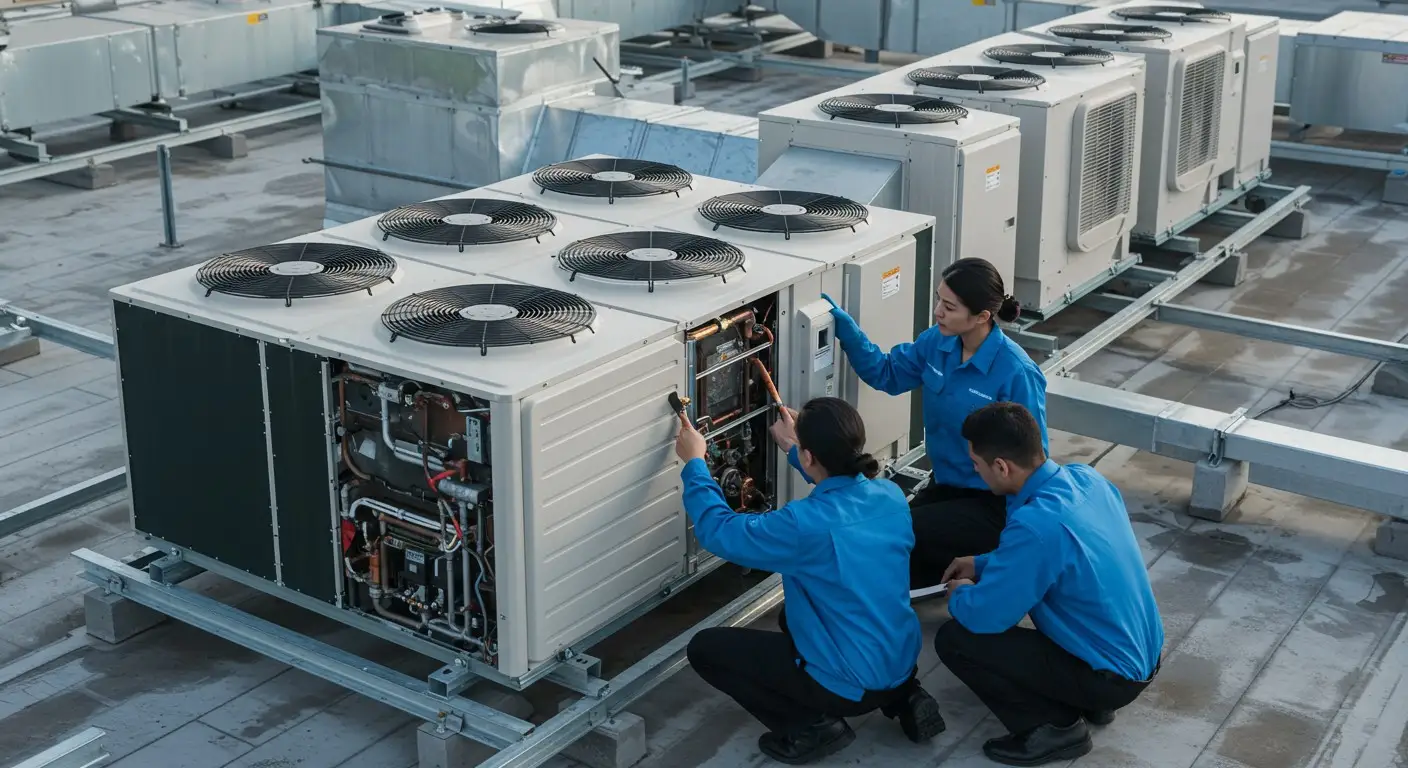
When you engage professional support for your facility, the focus shifts immediately to mitigating loss and restoring the environment. Commercial systems differ significantly from residential units in terms of complexity, voltage, and load distribution. A qualified provider handles the intricate needs of 10-ton to 25-ton (and larger) rooftop units, complex split systems, and specialized controls.
In the Boerne area, commercial operators often contend with systems that are undersized for the summer heat load or lack proper dehumidification. The service scope encompasses a full audit of your current mechanical setup. This includes checking refrigerant levels, inspecting electrical contactors for pitting, analyzing airflow static pressure, and verifying that the economizers are functioning correctly to utilize fresh air when appropriate.
Service capabilities include:
- Emergency Repair: addressing compressor failures, frozen coils, or electrical shorts that cause system outages.
- System Retrofits: Modifying existing ductwork or zoning controls to accommodate changes in floor plans or tenant usage.
- Preventive Maintenance: Routine cleaning of condenser coils, belt adjustments, and filter changes to adhere to warranty requirements.
- Component Replacement: Swapping out blower motors, heat exchangers, or expansion valves that have reached the end of their lifecycle.
Types of Systems Serviced
Commercial spaces vary wildly in their architectural constraints and cooling needs. The technical approach aligns with the specific equipment type powering your building.
- Rooftop Units (RTUs): These packaged units are common for retail and single-story office spaces. Service involves safe roof access, weatherproofing inspection, and checking the structural integrity of the curb adapter.
- Split Systems: Often used in smaller offices or server rooms, these require checking line sets running through plenums and ensuring proper drainage to prevent ceiling damage.
- VRF Systems: Variable Refrigerant Flow systems offer high efficiency for multi-zone buildings but require specialized diagnostic tools to troubleshoot the inverter-driven compressors and complex refrigerant branching.
- VAV Boxes: Variable Air Volume systems control airflow to specific zones. Maintenance ensures dampers open and close correctly based on thermostat demands.
The Commercial Installation and Replacement Process
Executing a commercial HVAC installation requires rigorous planning to ensure the new equipment meets both current building codes and future operational goals. Unlike a simple swap-out, a commercial replacement involves load calculations that account for lighting, computer equipment, occupancy rates, and solar gain through glass facades.
ReliaBee Air, Electric, & Plumbing follows a systematic approach to ensure installation accuracy and minimal disruption to your daily operations.
Site Assessment and Engineering
The process begins with a manual J or N calculation (commercial load calculation). Technicians evaluate the building envelope, insulation levels, and internal heat gains. This step determines the precise tonnage required. Undersizing leads to complaints and inability to hold temperature, while oversizing leads to short-cycling and humidity issues, which is particularly problematic in humid climates.
Logistics and Rigging
Commercial equipment is heavy and often located in difficult-to-reach areas.
- First, the logistics team coordinates with crane operators or lift services if the unit is located on the roof.
- Next, a safety perimeter is established to protect employees and customers during the lifting process.
- Then, old equipment is disconnected, checking for any refrigerant reclamation needs according to EPA Section 608 regulations.
Installation and Connection
Once the old unit is removed, the new installation proceeds.
- The curb adapter is inspected or replaced to ensure a watertight seal against the roof membrane.
- The new unit is set in place, and connections are made for high-voltage electrical, low-voltage controls, and gas lines (if heating is involved).
- Ductwork connections are sealed to prevent air leakage, which is a major source of energy waste.
Commissioning and Balancing
Installation is not complete until the system is commissioned.
- Technicians perform a start-up sequence to verify proper rotation of three-phase motors.
- Refrigerant charge is fine-tuned using subcooling and superheat methods.
- Air balancing ensures that every register and diffuser delivers the designed cubic feet per minute (CFM) of air.
- Finally, the thermostat or building automation system (BAS) is programmed to optimize schedules for occupied and unoccupied hours.
Diagnosing the Issue: When to Repair vs. Replace
For facility managers and business owners, the decision to repair or replace a commercial HVAC unit is strictly a financial one. It involves analyzing the Return on Investment (ROI) and the Total Cost of Ownership (TCO). While a repair might seem cheaper upfront, an aging, inefficient unit can bleed money through utility bills and frequent service calls.
The 50% Rule
A common industry standard for decision-making is the 50% rule. If the cost of the repair approaches or exceeds 50% of the value of the equipment, replacement is generally the smarter financial move. This is especially true if the unit is out of warranty, as you are investing significant capital into an asset with a depreciating value.
Equipment Age and ASHRAE Standards
According to ASHRAE (American Society of Heating, Refrigerating and Air-Conditioning Engineers), the average life expectancy of a commercial rooftop unit is roughly 15 to 20 years. If your equipment in Boerne is approaching this age range, major component failures (like compressors or heat exchangers) usually signal the end of the unit's reliable service life.
Refrigerant Considerations
Older units utilizing R-22 refrigerant are becoming prohibitively expensive to repair due to the global phase-out of this ozone-depleting substance. If your system leaks R-22, the cost of the refrigerant alone may justify upgrading to a modern unit that uses R-410A or newer, more environmentally friendly alternatives.
Energy Efficiency Ratings
Modern commercial units have significantly higher IEER (Integrated Energy Efficiency Ratio) and EER ratings compared to units manufactured a decade ago. Replacing a 10-SEER unit with a high-efficiency model can reduce cooling costs by 20% to 40%. For a business with high energy overhead, the savings on monthly utility bills can often offset the monthly financing cost of a new installation.
Navigating Local Regulations and Climate Challenges
Operating in the Texas Hill Country presents specific challenges that generic HVAC solutions fail to address. The combination of intense heat and variable humidity levels requires equipment that can adapt quickly.
Humidity Control and Indoor Air Quality
In this region, latent heat (humidity) is a major load on the system. If an AC unit simply cools the air without removing enough moisture, the indoor environment will feel clammy, and the risk of mold growth in ductwork increases. Commercial systems must be configured with proper reheating strategies or modulating compressors to handle humidity removal even when the temperature load is satisfied. This protects inventory and ensures a healthy environment for staff and clients.
Permitting and Code Compliance
Commercial HVAC work requires adherence to strict building codes.
- Permits: Replacing a commercial unit often triggers a requirement to bring the immediate area up to current code. This might include installing service outlets, updating disconnect switches, or adding condensate overflow protection.
- Electrical: Commercial units often run on three-phase power. Ensuring the voltage balance is correct is critical, as voltage imbalances can destroy motors.
- Ventilation: Codes dictate specific requirements for fresh air intake (ventilation) based on the occupancy type. Systems must be calibrated to bring in the correct amount of outside air to prevent "Sick Building Syndrome" while filtering out pollen and dust common in the area.
Seasonal Preparation
The transition from cooling to heating and back again can stress systems. In this climate, the cooling season is long, but the heating season, while shorter, can see sharp drops in temperature. Commercial heat exchangers must be inspected annually for cracks to prevent carbon monoxide leaks, a critical safety liability for any business.
Why Operational Reliability Matters
Choosing a service provider involves looking for technical proficiency and operational speed. Your business cannot afford to wait on parts or deal with technicians who are unfamiliar with commercial schematics.
Certified Expertise
Commercial systems are not just larger versions of residential units; they use different control logic and components. Technicians working on your property hold certifications that validate their ability to handle high-voltage electrical systems and complex refrigeration circuits. This ensures that the diagnosis is accurate the first time, preventing "parts changing" that drives up repair bills.
Minimizing Liability
Professional providers carry the necessary liability insurance and workers' compensation coverage. This protects your business from lawsuits or claims should an accident occur on your property during the repair or installation process. Furthermore, proper documentation of all repairs helps maintain manufacturer warranties, ensuring that if a part fails prematurely, you are covered.
Strategic Asset Management
Effective commercial HVAC management moves beyond fixing things when they break. It involves strategic planning for capital expenditures. By tracking the performance and repair history of your equipment, you can forecast when replacements will be necessary, allowing you to budget for them in the next fiscal year rather than being caught off guard by a catastrophic failure.
Secure Your Facility’s Climate Today
The stability of your business environment relies heavily on the performance of your heating and cooling infrastructure. Ignoring minor noises, short-cycling, or airflow issues can lead to expensive emergency shutdowns that impact your bottom line. Whether you need an immediate repair for a downed server room AC or a comprehensive proposal for retrofitting a retail complex, decisive action is required.
ReliaBee Air, Electric, & Plumbing delivers the technical precision and rapid response necessary to keep Boerne businesses operational. Do not let climate control issues dictate your productivity.
Contact our commercial division now to schedule a site assessment or request emergency service. — contact us today.

Current Offers for
San Antonio Homeowners
Free Plumbing Safety Check


$59 AC Tune-Up
5% OFF FOR SENIORS
5% OFF FOR VETERANS & FIRST RESPONDERS

5% OFF FOR EDUCATORS


What Your Neighbors Are Saying