EV Charger Installation in Balcones Heights, TX

Need a Fast EV Charger Installation? We've Got You Covered
Finding a reliable and quick installation for your EV charger can be stressful, especially when you just want to get your vehicle on the road without worrying about electrical hazards. ReliaBee Air, Electric, & Plumbing offers certified installers who handle everything from permit to power-up for homeowners in Balcones Heights. Call us or apply for financing today to get your charging station set up immediately:
- Certified installers ensure compliance and quality.
- Transparent pricing with no hidden fees.
- Hassle-free setup completed to your schedule.
- All installations come with a 1-year warranty and optional financing.
What’s Included in Your Charger Installation Service
When you commit to a professional installation, you are purchasing more than just a wall-mounted device; you are investing in a comprehensive electrical upgrade designed to support the high-demand load of an electric vehicle. A standard wall outlet is rarely sufficient for daily driving needs, necessitating a dedicated Level 2 setup. Our service covers the entire scope required to transform your garage or driveway into a fully functional fueling station.
This service begins with the electrical infrastructure. We supply and install the appropriate circuit breaker in your main panel. Because EVs draw a continuous high load, the breaker must be sized strictly according to the manufacturer’s specifications—typically ranging from 40 to 60 amps—to prevent overheating and nuisance tripping. We ensure the wire gauge used (often copper for better conductivity and heat resistance) matches the amperage distance of the run, minimizing voltage drop and ensuring your vehicle receives the maximum possible charge rate.
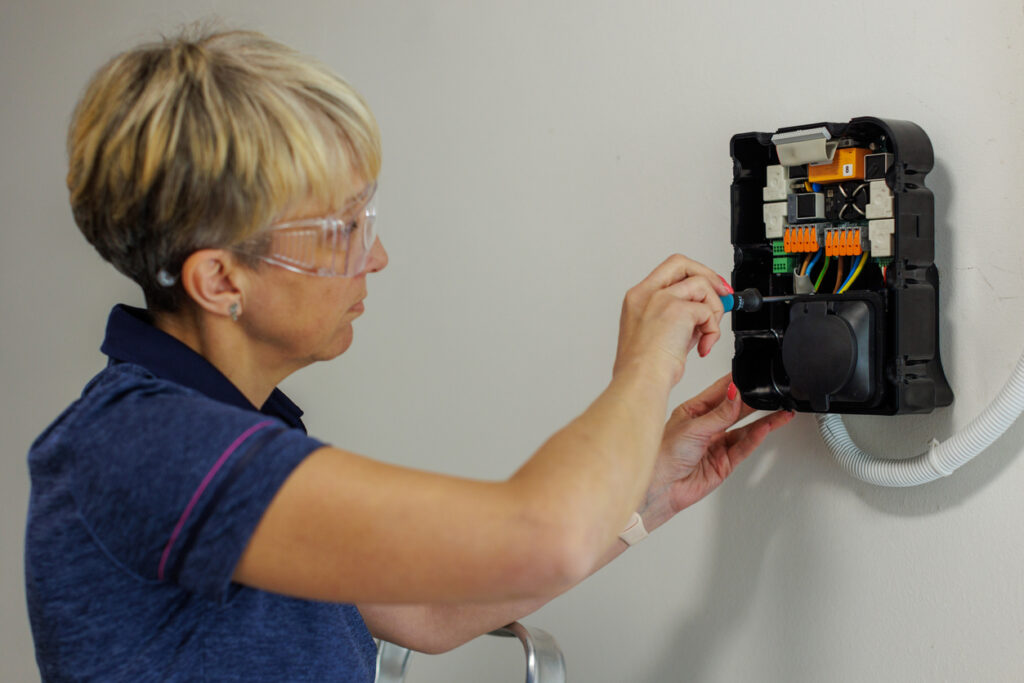
The installation also includes the physical mounting of the Electric Vehicle Supply Equipment (EVSE). Whether you have purchased a specific unit like a Tesla Wall Connector, a ChargePoint Home Flex, or require us to supply a top-rated universal charger, we securely mount the unit to wall studs or masonry. Proper mounting ensures the unit can withstand the daily wear and tear of plugging and unplugging cables. If your location requires it, we install conduit to protect the wiring from physical damage and environmental exposure.
We also handle the distinction between hardwired units and plug-in units. A hardwired connection—where the conduit runs directly into the charger—is generally preferred for outdoor installations or higher amperage units, as it offers better weather protection and eliminates the failure point of a receptacle. However, if you prefer portability, we can install a commercial-grade NEMA 14-50 outlet. This heavy-duty receptacle is designed to handle the thermal stress of EV charging, unlike standard range outlets found in big-box stores.
The Installation Process: What to Expect
A professional installation follows a rigorous, linear workflow designed to ensure safety and code compliance. We do not skip steps or cut corners with electrical loads of this magnitude. Understanding the sequence of events helps you prepare your home for the arrival of our technicians:
- Site Assessment and Load Calculation: Before any wire is run, we perform a load calculation on your home’s existing electrical panel. This determines if your current service (usually 100A or 200A) has enough spare capacity to handle the additional load of an EV charger without overloading the main breaker. If your panel is full or at capacity, we will identify the need for a service upgrade or a load management device.
- Permitting and Code Compliance: Electrical work of this nature generally requires a permit from the city or county. We manage the paperwork and submission process. This step is critical for your home insurance validity and ensures that the work meets the National Electrical Code (NEC).
- Circuit Installation and Rough-In: The technician will shut off power to the relevant sections of your home to work safely. We then run the conduit and wiring from your electrical panel to the designated charging location. This may involve routing wire through attics, crawlspaces, or along exterior walls depending on the layout of your property in Balcones Heights.
- Termination and Mounting: Once the wiring is in place, we terminate the connections at both the breaker panel and the charging station. Torque specifications are strictly followed; loose connections are the leading cause of electrical fires in high-load circuits. The unit is leveled and mounted securely.
- Commissioning and Testing: After power is restored, we do not simply leave. We test the voltage and amperage levels to ensure stability. If the charger is a smart unit, we assist in connecting it to your local WiFi network, ensuring the firmware is updated and the unit is communicating with your smartphone app for charge scheduling.
- Final Inspection: We coordinate with local building inspectors to review the work, ensuring it passes all safety checks and closes out the permit.
Choosing Between New Installation vs. Upgrading
Homeowners often face the decision between sticking with the standard charging cable provided with the car (Level 1) or investing in a dedicated Level 2 station. Understanding the technical limitations of your current setup is key to making the right decision for your driving habits:
The Limitations of Level 1 Charging
Level 1 charging utilizes a standard 120-volt household outlet. While this requires no installation, it is extremely slow, typically adding only 3 to 5 miles of range per hour of charging. If you commute more than 30 miles a day or own a vehicle with a large battery pack, a Level 1 charger will struggle to replenish the battery overnight. This leads to "range anxiety," where you start your day with less than a full charge. If you rely on your EV for daily commuting in Texas, relying solely on Level 1 is rarely sustainable long-term.
The Efficiency of Level 2 Installation
A Level 2 installation, utilizing 240 volts, drastically reduces charging time. Depending on the amperage, these units can add 25 to 60 miles of range per hour. This allows you to completely recharge a depleted battery overnight, taking advantage of off-peak electricity rates if available. If you have purchased a new EV or are finding your current charging speeds inadequate, a new Level 2 installation is the correct operational choice.
Upgrading an Existing Setup
If you already have a 240-volt outlet (like a dryer outlet) in the garage, you might assume you are set. However, standard household outlets are not rated for the continuous, high-duty cycle of EV charging. Upgrading to an EV-rated receptacle or converting that circuit to a hardwired connection is safer and more reliable. Furthermore, if you are upgrading from a plug-in hybrid to a full battery electric vehicle, you may need to upgrade the wiring gauge and breaker size to support faster charging speeds, as older circuits may be limited to lower amperages that throttle your new vehicle’s charging capability.
Balcones Heights Specifics: Permits and Best Installation Times
Local environmental and regulatory factors play a significant role in how your EV charger is installed and how it performs. In Balcones Heights, specifically, heat management and regulatory compliance are top priorities:
- Heat Derating: The region experiences significant heat, particularly in the summer months. EV chargers and the cables attached to them generate heat during operation. If a charger is installed in a non-climate-controlled garage or on a west-facing exterior wall exposed to direct sunlight, the internal thermal sensors may "derate" the unit. This means the charger will automatically lower the charging speed to protect itself from overheating. We strategically plan installation locations to minimize thermal exposure, ensuring you get maximum charging speeds even during peak summer temperatures.
- Permit Requirements: Local municipalities enforce the National Electrical Code (NEC) strictly regarding EVSE. This includes requirements for GFCI protection on outlets and specific disconnect switches depending on the location of the unit. Unpermitted work is a liability; if an electrical fire occurs due to DIY or handyman work, insurance claims are frequently denied. We ensure all local specific codes are met, including load calculations that prove the grid connection to the home is not compromised.
- Grid Stability: While the local grid is generally robust, severe weather events can cause fluctuations. For high-value electronics like an EV and its charger, we often recommend the installation of a Type 2 Whole House Surge Protection device at the main panel during the charger installation. This protects the vehicle's onboard charging computer from voltage spikes that can originate from the utility side or internal switching.
Why Choose ReliaBee Air, Electric, & Plumbing? Our Credentials Speak
Selecting the right contractor for high-voltage work is a decision that impacts the safety of your home and the longevity of your vehicle. We focus on technical precision and code compliance rather than quick fixes.
We employ only licensed electricians who specialize in residential load management and EVSE technology. Unlike general handymen, our team understands the nuances of continuous load circuits. We know that an EV charger runs at maximum capacity for hours at a time—a stress test that reveals the slightest weakness in wiring or connections. We use industrial-grade materials, from the copper wiring to the conduit fittings, ensuring the installation lasts as long as the home itself.
We are brand-agnostic but technology-focused. Whether you drive a Tesla, Ford, Rivian, or Hyundai, we install the equipment that matches your vehicle's acceptance rate and your home’s electrical capacity. We navigate the technical specifications of J1772 connectors and NACS (North American Charging Standard) adapters so you don't have to guess about compatibility.
Our commitment extends beyond the physical install. We verify the functionality of the unit before we leave and provide clear documentation on how to operate your new station. With ReliaBee Air, Electric, & Plumbing, you receive a partner in your transition to electrification, ensuring your infrastructure is safe, efficient, and ready for the road.
Secure your charging independence and eliminate the wait times of public stations.
Schedule your professional site assessment and installation today.

Current Offers for
San Antonio Homeowners
Free Plumbing Safety Check


$59 AC Tune-Up
5% OFF FOR SENIORS
5% OFF FOR VETERANS & FIRST RESPONDERS

5% OFF FOR EDUCATORS


What Your Neighbors Are Saying